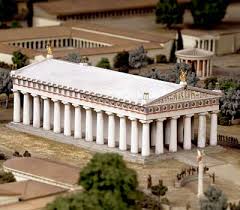
It housed the cult statue of Zeus which was one of the Seven Wonders of the Ancient World. The Chryselephantine statue was approximately 13 m (43 ft) high and was made by the sculptor Phidias in his workshop on the site at Olympia. He took about twelve years to complete it. On his head was a sculpted wreath of olive sprays. In his right hand he held a figure of Nike, the goddess of victory, also made from ivory and gold, and in his left hand, a scepter made with many kinds of metal, with an eagle perched on the top. His sandals were made of gold and so was his robe. His garments were carved with animals and with lilies. The throne was decorated with gold, precious stones, ebony, and ivory. The statue was the most famous artistic work in Greece.
The temple was constructed by the architect Libon, with carved metopes and triglyph friezes, topped by pediments filled with sculptures in the Severe Style, now attributed to the Olympia Master and his studio.
The main structure of the building was of a local limestone that was unattractive and of poor quality, and so it was coated with a thin layer of stucco to give it an appearance of marble. All the sculptural decoration on the temple was made of Parian marble, and the roof tiles were of the same Pentelic marble used to build the Parthenon at Athens.
The unifying theme of iconography of the temple is the dike or justice based on custom, as represented by Zeus, its upholder.
The east pediment, erroneously attributed to Paeonius by Pausanias, who gave a detailed account of its sculptures in the late second century CE, depicted the myth of the chariot race between Pelops and Oenomaus, with Zeus standing in the centre, flanked by standing pairs of heroes and heroines, and the two chariot groups, with recumbent figures in the corners. Hippodameia and her maid stand to Zeus' left (north), and Pelops to Zeus' right. A great part of all fifteen figures has been recovered, in carefully documented excavations; scholars still discuss the placement and interrelationships of six seated or kneeling figures in the composition, and their specific identifications.
The west pediment depicted the Centauromachy, the fight at the wedding of Peirithoos between the Lapiths and the centaurs, who had violated xenia, the sacred rules of hospitality that support the social norms. Apollo stood in the centre, flanked by Peirithoos and Theseus. The Lapiths have been taken to represent the civilised Olympian order of the Greeks themselves, while the Centaurs represent primitive nature of chthonic beings; the frieze also reminded fifth-century Greeks of their victory over the Persians, "outsider" threateners of the Hellenic order. The statue of Apollo (currently in the Olympia Archaeological Museum) was depicted on the obverse of the Greek 1000 drachmas banknote of 1987-2001.
The pronaos and opisthodomos, the entrance portico and the balancing false portico at the rear, were constructed in antis, with six metopes at either end, carved with the 12 labours of Heracles, in which Heracles successfully defeats a series of creatures and monsters that threaten righteous order.
The Roman general Mummius dedicated twenty-one gilded shields after he sacked Corinth in 146 BCE; they were hung upon the columns. In 426 CE, Theodosius II ordered the destruction of the sanctuary, and earthquakes in 522 and 551 devastated the ruins and left the Temple of Zeus partially buried.
The site of the ancient sanctuary, long forgotten under landslips and flood siltation, was identified in 1766. In 1829 a French team partially excavated the Temple of Zeus, taking several fragments of the pediments to the Musée du Louvre. Systematic excavation began in 1875, under the direction the German Archaeological Institute, and has continued, with some interruptions, to the present time.
18 September 2009
Temple of Zeus


17 September 2009
Rockfort Ucchi Pillayar Temple

Etymology
The name rock fort comes from the fact that the place was used for military fortification first by the Vijayanagar emperors and later by the British during the Carnatic wars
Architecture
The Rock Fort temple stands 83m tall perched atop the rock. The smooth rock was first cut by the Pallavas but it was the Nayaks of Madurai who completed both the temples under the Vijayanagara empire.
The temple complex is composed of two parts: a Shiva temple (Thayumanaswamy) carved in the middle of the rock and a Pillayar (Ganesh)temple at the top portion of the rock[1]. The Shiva temple is the bigger one, housing a massive stone statue of Shiva in the form of Linga along with a separate sanctum for goddess Parvati. The temple is mystic in its nature with an awe-inspiring rock architecture. The Ganesh temple is much smaller with an access through steep steps carved on the rock and provides a stunning view of Trichy, Srirangam and the rivers Kaveri and Kollidam. Due to its ancient and impressive architecture created by the Pallavas, the temple is maintained by the Archaeological department of India.
Mythology of the Vinayaka temple
Vibhishana, was the younger brother of the Asura King Ravana who ruled Lanka (now known as Srilanka). Lord Rama in the epic of Ramayana rescues his wife Sita, who was kidnapped and held by Ravana, with the help of Sugriva and Hanuman defeated him. In this war, the moral and truth-abiding brother of Ravana, Vibishana aids Rama in his battle against his brother. Ultimately Rama wins the war and as a token of love, He gifts Vibishana an Idol of Lord Ranganatha, a form of Vishnu.
Vibhishana, though he supported Rama, was basically an Asura, hence the Devas (who are arch rivals to Asuras as per Hindu mythology) wanted to stop this idea of an Asura taking Lord's supreme form to his Kingdom. They request the help of the God of Happiness, Lord Vinayaka and the Lord accepts the plan. Vibhishana, while on his back to his Kingdom, goes through Trichi, and wanted to take his bath in the river Kaveri and do his daily rituals. However, he is perplexed as the idol once kept in land, can never be removed and has to be in that place forever.
As a solution, Vibishana tries to find someone to hold the idol while he was taking bath and finds the Lord Vianayaka under disguise of a cowherd boy. As per the plan, when Vibishana is fully into water, Vinayaka takes the statues and keeps it firmly in sand, in the banks of kaveri. On seeing this, the angry Vibhishana chases the boy, to punish him, and boy keeps running and climbs over the rock near the Kaveri bank. Vibhishana finally reaches the boy and hits him on the fore-head of little boy who then reveals himself to be Vinayaga. Vibishana immediately apoligizes and the Lord gives him his blessings and sends him off to Lanka.
The place on which the Ranganathan idol was kept was later covered in deep forests, due to disuse and after a very long time, it is discovered when a Chola king chasing a parrot finds the idol accidentally. He then establishes the Ranganathaswamy temple,Srirangam as one of the largest temple complexes in the world. Meanwhile, the Pallavas built the Vinayaka temple and the Thayumanaswamy temple, in the rock which Vinayaka uses to escape Vibishana.


16 September 2009
Flying pterosaurs runway Found

One of Paleontology at the University of Berkeley, California, United States, said Kevin grains no other animal-shaped making tracks in the world pterosaurs foot when about to take off or landing.
In fact, continued grains, pterosaurs did have a great ability to fly, where he could control the beating of wings. Researchers are expected in the future are better able to uncover traces left by these flying reptiles, and can provide an explanation of how the prehistoric flying creature that has long extinct. "There are hundreds of footprints are visible in this hunt," he said as quoted by LiveScience grains, recently.
However, a rebuttal statement from an expert at the Institute of Fossil Animals and Study Center for Ancient Man in Beijing, China, David Hone. "Pterosaurs like birds in general, very light weight and do not always leave a trail when compared to a sauropod weighing 50 tons."
"If the trail can be traced from the pterosaurs, as well as seeing impressions in soft mud or sand. But pterosaurs discovered the landing track is an interesting thing," added Hone again. He also said that if the discovery of the researchers on the landing point pterosaurs very convincing.


Dinosaurs
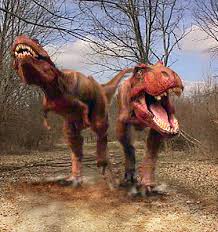
The term "dinosaur" was coined in 1842 by Sir Richard Owen and derives from Greek δεινός (deinos) "terrible, powerful, wondrous" + σαῦρος (sauros) "lizard". It is sometimes used informally to describe other prehistoric reptiles, such as the pelycosaur Dimetrodon, the winged pterosaurs, and the aquatic ichthyosaurs, plesiosaurs and mosasaurs, although none of these animals were dinosaurs. Through the first half of the 20th century, most of the scientific community believed dinosaurs to have been slow, unintelligent cold-blooded animals. Most research conducted since the 1970s, however, has supported the view that dinosaurs were active animals with elevated metabolisms and numerous adaptations for social interaction. The resulting transformation in the scientific understanding of dinosaurs has gradually filtered into popular consciousness.
The 1861 discovery of the primitive bird Archaeopteryx first suggested a close relationship between dinosaurs and birds. Aside from the presence of fossilized feather impressions, Archaeopteryx was very similar to the contemporary small predatory dinosaur Compsognathus. Research has since identified theropod dinosaurs as the most likely direct ancestors of birds; most paleontologists today regard birds as the only surviving dinosaurs, and some suggest that dinosaurs and birds should be grouped into one biological class.[1] Aside from birds, crocodilians are the only other close relatives of dinosaurs to have survived until the present day. Like dinosaurs and birds, crocodilians are members of Archosauria, a group of reptiles that first appeared in the very late Permian and came to predominate in the mid-Triassic.
Since the first dinosaur fossils were recognized in the early nineteenth century, mounted dinosaur skeletons have become major attractions at museums around the world. Dinosaurs have become a part of world culture and remain consistently popular. They have been featured in best-selling books and films (notably Jurassic Park), and new discoveries are regularly covered by the media.


