
One of Paleontology at the University of Berkeley, California, United States, said Kevin grains no other animal-shaped making tracks in the world pterosaurs foot when about to take off or landing.
In fact, continued grains, pterosaurs did have a great ability to fly, where he could control the beating of wings. Researchers are expected in the future are better able to uncover traces left by these flying reptiles, and can provide an explanation of how the prehistoric flying creature that has long extinct. "There are hundreds of footprints are visible in this hunt," he said as quoted by LiveScience grains, recently.
However, a rebuttal statement from an expert at the Institute of Fossil Animals and Study Center for Ancient Man in Beijing, China, David Hone. "Pterosaurs like birds in general, very light weight and do not always leave a trail when compared to a sauropod weighing 50 tons."
"If the trail can be traced from the pterosaurs, as well as seeing impressions in soft mud or sand. But pterosaurs discovered the landing track is an interesting thing," added Hone again. He also said that if the discovery of the researchers on the landing point pterosaurs very convincing.
16 September 2009
Flying pterosaurs runway Found


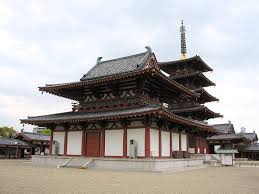
The Shiten'no-ji Temple
The Shiten'no-ji Temple was built late in the 6th century by Shotoku-taishi (Prince Shotoku), a son of Emperor Yomei, as a token of his gratitude to the Four Devas (Shi-tenno), the guardians for Buddhism and Buddhists, for responding to his prayer to let him overthrow Mononobe-no-Moriya, an anti-Buddhist administrator, in the 6th century.
With its middle gate, tower, main hall and lecture hall arrangned from south to north in a beeline, which is known as "Shiten'no-ji type temple layout" modeled after the then Chinese style of architecture, the Shiten'no-ji Temple typifies the Buddhist structures built in the Asuka Period from the late 6th century through the early 7th century together with the Horyu-ji Temple, a World Cultural Heritage, in Nara. Soon afer its erection, the temple had a free dispensary (Seyaku-in) and other welfare facilities set up in its precincts to give the poor free medicines and treatment and provide free accommodations for the aged without family and infants, opening the way to public welfare service in Japan.
In January, there is "Doya-Doya," a festival in which the young scramble for paper charms. Autumn is the time when "Shiten'no-ji Wasso, " a festival reproducing a bit of the history of cultural interchange between the ancient Korean Peninsula and Japan, takes place.


Temple Mount
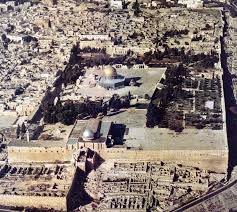
The Temple Mount contains the holiest site in Judaism. Jewish Midrash holds that it was from here that the world expanded into its present form, and that this was where God gathered the dust he used to create the first man, Adam. The Torah records that it was here that God chose to rest His Name and Divine Presence, and consequently two Jewish Temples were built at the site. According to Jewish tradition, the Third Temple will also be located here, and will be the final one. In recent times, due to difficulties in ascertaining the precise location of the Mount's holiest spot, many Jews will not set foot on the Mount itself.
The Noble Sanctuary is the third holiest site in Islam, revered as the destination of Muhammad's journey to Jerusalem, and the location of his ascent to heaven. The site is also associated with all the Jewish biblical prophets who are also revered in Islam. The site is the location of the al-Aqsa Mosque and the Dome of the Rock, the oldest extant Islamic structure in the world.[1]
Controlled by Israel since 1967, both Israel and the Palestinian Authority claim sovereignty over the site, which remains a key issue in the Arab-Israeli conflict. A Muslim council, known as the Muslim Waqf, manages the site. The Israeli government enforces a controversial ban on prayer by non-Muslim visitors.
History
Early history
The hill is believed to have been inhabited since the 4th millennium BCE. Its southern section was walled at the beginning of the 2nd millennium BCE, in around 1850 BCE, by Canaanites who established a settlement there named Jebus. It was this city that King David captured in around 1000 BCE and renamed the City of David.David intended to build a sanctuary to God, as the first temple of the Israelites in Jerusalem, outside the city walls on the northern edge of the hill. He purchased the area, which the Bible refers to as Mount Moriah, from Araunah who owned the site. David's son Solomon completed the task of erecting the First Temple at the site in 960 BCE. Solomon’s Temple was destroyed by Nebuchadnezzar II of Babylon in 586 BCE.
Achaemenid Persian, Hasmonean periods, and Herod’s expansion
Much of the Mount's early history is synonymous with events pertaining to the Temple itself. After the destruction of Solomon’s Temple by Nebuchadnezzar II of Babylon in 586 BCE, construction of the Second Temple is understood to have begun under Cyrus in around 538 BCE, and completed in 516 BCE. Evidence of a Hasmonean expansion of the Temple Mount has been recovered by archaeologist Leen Ritmeyer. Around 19 BCE, Herod the Great further expanded the Mount and rebuilt the temple. The ambitious project, which involved the employment of 10,000 workers, more than doubled the size of Temple Mount to approximately 36 acres (150,000 m2). Herod leveled the area by cutting away rock on the northwest side and raising the sloping ground to the south. He achieved this by constructing huge buttress walls and vaults, filling the necessary sections with earth and rubble. In addition to restoration of the Temple, its courtyards, and porticoes, Herod also built Antonia Fortress abutting the northwestern corner of the Temple Mount, and a rainwater reservoir, Birket Israel, in the northeast. As a result of the First Jewish-Roman War, the fortress was destroyed by Roman emperor Vespasian, in 70 CE, under the command of his son and imperial heir, Titus.
Middle Roman period
The city of Aelia Capitolina was built in 130 CE by the emperor Hadrian, and occupied by a Roman colony on the site of Jerusalem, which was still in ruins from the First Jewish Revolt in 70 CE.
Aelia came from Hadrian's nomen gentile, Aelius, while Capitolina meant that the new city was dedicated to Jupiter Capitolinus, to whom a temple was built on the site of the former second Jewish temple, the Temple Mount.
Hadrian had intended the construction of the new city as a gift to the Jews, but since he had constructed a giant statue of himself in front of the Temple of Jupiter and the Temple of Jupiter had a huge statue of Jupiter inside of it, there were now two enormous graven images on the Temple Mount. It was also the normal practice of the adherents of the Hellenic religion to sacrifice pigs before their deities. In addition to this, Hadrian issued a decree prohibiting the practice of circumcision. These three factors, the graven images, the sacrifice of pigs before the altar, and the prohibition of circumcision, constituted for non-Hellenized radical Zealot Jews a new abomination of desolation, and thus Bar Kochba launched the Third Jewish Revolt. After the Third Jewish Revolt failed, all Jews were forbidden on pain of death from entering the city.
Late Roman period
About 325 it is believed that Constantine's mother, St. Helena, built a small church on the Mount in the 4th century, calling it the Church of St. Cyrus and St. John, later on enlarged and called the Church of the Holy Wisdom. The church was later destroyed and on its ruins the Dome of the Rock was built. Since it is known that Helena ordered the Temple of Venus to the west of the Temple Mount to be torn down to construct the Church of the Holy Sepulchre, presumably she also ordered the Temple of Jupiter on the Temple Mount to be torn down to construct the Church of St. Cyrus and St. John.
Byzantine period
Archaeological evidence in the form of an elaborate mosaic floor similar to the one in the Church of the Nativity in Bethlehem and multiple fragments of an elaborate marble Templom (chancel screen) prove that an elaborate Byzantine church or monastery stood on the Temple Mount in Byzantine times, presumably the aforementioned Holy Wisdom Church.
Sassanid vassal state period
Caliph Omar ordered a mosque to be constructed at the southeast corner, facing Mecca, near which the al-Aqsa Mosque was built 78 years later. The original building is now known to have been wooden and to have been constructed on the site of a Byzantine church with an elaborate mosaic floor. (The Persian conquest that immediately preceded the Arab conquest makes it uncertain who destroyed the church.)
In 691 an octagonal Muslim building topped by a dome was built by the Caliph Abd al Malik around the rock, for political reasons, in violation of the Caliph Omar's teachings. The shrine became known as the Dome of the Rock (Qubbat as-Sakhra قبة الصخرة). The dome itself was covered in gold in 1920. In 715 the Umayyads led by the Caliph al-Walid I, rebuilt the Temple's nearby Chanuyos into a mosque (see illustrations and detailed drawing) which they named al-Masjid al-Aqsa المسجد الأقصى, the al-Aqsa Mosque or in translation "the furthest mosque", corresponding to the Muslim belief of Muhammad's miraculous nocturnal journey as recounted in the Quran and hadith. The term al-Haram al-Sharif الحرم الشريف (the Noble Sanctuary) refers to the whole area that surrounds that Rock as was called later by the Mamluks and Ottomans.
The structures have been ruined or destroyed several times in earthquakes;[citation needed] the current version dates from the first half of the 11th century. For Muslims, the importance of the Dome of the Rock and al-Aqsa Mosque makes Jerusalem the third-holiest city, after Mecca and Medina. The mosque and shrine are currently administered by a Waqf (an Islamic trust).
In 1867, a team from the Royal Engineers, led by Lieutenant Charles Warren (later the London police commissioner of Jack the Ripper fame) and financed by the Palestine Exploration Fund (P.E.F.), discovered a series of tunnels beneath Jerusalem and the Temple Mount, some of which were directly underneath the headquarters of the Knights Templar. Various small artifacts were found which indicated that Templars had used some of the tunnels, though it is unclear who exactly first dug them. Some of the ruins which Warren discovered came from centuries earlier, and other tunnels which his team discovered had evidently been used for a water system, as they led to a series of cisterns.
Post 1967
During the 1967 Six-Day War Israel captured the Temple Mount. The Chief Rabbi of the Israeli Defense Forces, Shlomo Goren, led the soldiers in religious celebrations on the Temple Mount and at the Western Wall. The Israeli Chief Rabbinate also declared a minor religious holiday on the anniversary, called "Yom Yerushalayim" (Jerusalem Day), which also became a national holiday.


13 September 2009
Free Photo Effect OnLine

PhotoFunia was originally developed by two enthusiasts from Odessa, Ukraine and has officially launched on the 11th August 2007.
here is the link photofunia
Sample of photofunia


